 by Paul Kekai Manansala
 by Paul Kekai Manansala
Share article: Tweet
The Dog Story: "When old dogs bark, it's time to watch out."
Although maligned in some cultures as "unclean," a thorough historical review will reveal that few if any animals have been as revered as the dog.
This is even more true when one considers the dog along with its wild ancestor the wolf. Since many biologists now classify the two as the same species -- Canis lupus -- it is valid to examine the history of the two together.
Indeed, from the genetic standpoint the dog does not even qualify as a subspecies of the wolf. A subspecies would normally require a 20-25 percent genetic divergence. The divergence between human "races" is about 6 percent and within "races" about 8 percent.
However, dogs and wolves diverge genetically by only 1 percent. And as with human races, the divergence within each group is greater than that between the two groups.
"By the Dog of Egypt"
When looking at the dog in historical records, few are older than those of the ancient Egyptians.
According to the testimony of the ancient Greeks, the Egyptians loved dogs and treated them with great respect. Dogs received burial in family tombs and family members would shave their heads in mourning at the death of a family dog.
Even in the predynastic period, we see that the Egyptians were already burying dogs in the same way they buried humans with plenty of goods for the afterlife. In dynastic Egypt, dog mummies were made with great care and expense. At Hardai, the sacred city of the god Anubis there are sprawling dog cemetaries.
When thinking of dogs as deities few come to mind as quickly as Anubis (aka Anpu). While sometimes represented clearly as a dog, at other times he appears more like a jackal.
The most common representation appears like a cross between a dog and a jackal and/or wolf. The same image is commonly used to portray Wepwawet, another important if lesser known Egyptian deity. This portrayal has led some to believe that the Egyptians may have interbred domestic dogs with the wild dogs of Egypt, and in particular the jackal and wolf.
Anubis was one of the most ancient of Egyptian gods closely associated with funerary rites and the afterlife. He was guide to the dead and the one who weighted the souls of the deceased against the feather of Maat (truth and order). Socrates referred to Anubis when he swore "by the Dog of Egypt."
The Greeks called Hardai by the name Cynopolis "Dog City" revealing how they identified this god. During Roman times, mummified dogs were placed at Anubis temples. Also the fact that Hardai was teeming with dog cemetaries makes it very clear that this deity was at least partly associated with the domestic canine.
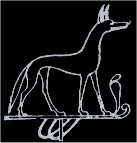 While the Greeks called Anubis sacred city Cynopolis, the city of Wepwawet was known as Lycopolis "Wolf City." The original king of the dead before Osiris took that position, Wepwawet was intimately connected with Egyptian royalty. The Lord of the Dead in Egyptian religion was the King of Kings and Wepwawet's original honor survived in his placement on two of the four royal standards.
The king's standard, the shedshed with the form of the royal placenta had an image of Wepwawet and was used to lead Pharaoh's armies into battle. It was also supposed to carry Pharaoh into heaven after his death. Wepwawet's own standard was the other of the four, and represented Upper Egypt, the unification of the two lands and the Egyptian nobility.
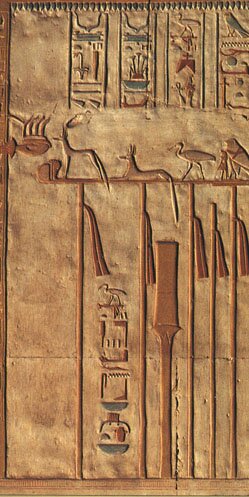 Like Anubis, Wepwawet was one of the older Egyptian gods, the oldest of Abydos, home of Egypt's first dynasty. His sacred city was Asyut near the border of Upper and Lower Egypt. Anubis was the lord of the Asyut necropolis.
After reliquinshing the title of Lord of the Dead to Osiris, Wepwawet became mainy associated with royalty, war and the unification rites, although he continued to have funerary significance.
Like Anubis, Wepwawet appeared to be associated at various times with the wolf, dog and jackal and often with an apparent cross of these types.
Another prominent god who appeared most often in dog form was Set. Also an ancient god, Set's popularity declined with time. He was a god of the desert and the storm and was best known for his conflict with Osiris, and the latter's son Horus. Although portrayed as a number of animals and also as a human with possibly an aardvark's head, Set in full animal form was usually represented as a dog.
One hieroglyph variant of his name has an image of his dog form somewhat resembling a greyhound.
Originally Set was the equal of Osiris, but as that god and his son Horus rose in popularity, Set became more demonic in quality. He was symbolized Lower Egypt until the Hyksos invaders adopted him as their patron god. After the Hysos were driven from Egypt, Set became the practical equivalent of the devil.
 Even Osiris, one of the most prominent deities of ancient Egypt, was sometimes portrayed as a dog often together with Anubis. The latter according to some accounts was the son of Osiris. Another one of Osiris son's, Duamatef, lord of one of the canopic jars, also had a jackal/dog head. With two canine-headed sons it is no wonder that Osiris should also be represented in this form. In latter times, he became associated with Khentamentiu, the dog/jackal lord of the royal cemetary of Abydos, as Osiris-Khentamentiu.
Djehuty, also known as Thoth, the god of Maat and wisdom, although mainly associated with the ibis and baboon could also appear as a monkey with a dog's head.
Dancing with wolves
The indigenous people of the Americas revered the wolf, coyote and the domestic dog.
Some tribes were known as the "Wolf People" like the Mohican or Mohegan. The Pawnee were known by other tribes by a similar name. Numerous tribes had wolf divisions or bands. Also, animist wolf societies were very pervasive and widespread.
It is interesting to note that while the ancient Egyptians associated the star Sirius with the dog calling it the "Dog Star," the Pawnee knew Sirius as the "Wolf Star." Medicine men and shamans donned wolf clothing before rituals.
Both the Amerindians and the Inuit regularly crossed their domestic dogs with wolves. There are repeated accounts of tribes that captured wolf or coyote whelps to mate with their dogs. The captive wolves and the wolf crosses were kept as pets and working animals. Thus, as with in ancient Egypt, the line between wild and domestic dog was blurred.
The coyote god of the indigenous Americans was often the trickster or culture hero and sometimes the creator of humans and/or the Milky Way. The Pawnee and Blackfoot Indians of Canada knew the Milky Way as the "Wolf Trail." Both the coyote and dog appear in numerous North American Indian creation and deluge myths.
Dogs were highly prized among most indigenous American peoples. Among some tribes an average family would have about 30 dogs. This may seem fantastic until one considers the economic value of dogs. They were used for hunting and for transporting the meat of kills either by backpack or pulling devices known as travois. The transport role of dogs was important also among the many nomadic Indian tribes.
In most cases, dogs were treated like family members often living in the home and eating along with the family. They were often accorded burial and mourning rites. In many Indian tribes, people might be known as the father, mother, brother or sister of such-and-such a dog. The Inuit, in particular, accorded very special care for their dogs as their own survival rested largely on their canine friends.
Dog worship extended into Central and South America also. One of the important concepts here is that of the nahuali or animal twin. Not only humans but gods had nahauli. The twin of Quetzalcoatl, the Toltec god of goodness and light, was the dog god Xolotl. The latter was a guide of the dead and of the Sun, and also the personification of the planet Venus, the most important Mesoamerican planet/star.
In Mesoamerican art, Xolotl is portrayed as a man with a dog's head. He is said to have created a protector and guide for humans in the underworld in the form of the hairless dog, the Xoloitzcuintle.
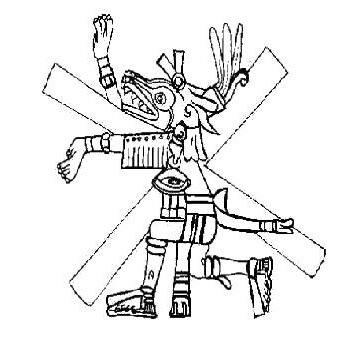 Both Quetzalcoatl and Xolotl also appear as earthly rulers and the Vienna Codex states that nine successors of Quetzalcoatl took the same name. The great Chichimec conqueror who replaced the Toltecs as the dominant power in Mexico was named Xolotl. The name "Chichimec" refers to those "of dog lineage."
The Lineage of the Blue Wolf
Among most Turko-Mongol and Siberian peoples, the wolf and dog hold a very high place. One of the most well-known traditions in this regard is the descent of the great Mongol conqueror Genghis Khan from the wolf and the doe.
Many modern Mongolians were stripped of their surnames during the height of the communist revolution in Mongolia. With the government now allowing people to adopt new surnames most have chosen to claim descent from Genghis. They have adopted his tribal name Borjigin, "the blue wolf."
From Turkey to the Kamchatka penisula one people after another are found who at one time either worshiped the wolf as a god or as an ancestor.
Turkic people like the Kazakhs, Uygyrs and Uzbeks consider the gray wolf as the mother of all Turks. In accordance with these ancient traditions, Kemal Ataturk, the founder of modern secular Turkey, is known affectionately as the "Gray Wolf."
As we have seen before, where the wolf is revered the dog also usually holds a high position. Among present-day Mongolians, the dog's place in the family is more similar to that of the parents than that of the children. It is said that Mongolians often judge visitors by whether the family dog takes to the guest or not. The widespread belief is that people reincarnate from dogs so one should never hit a dog as it may become one's own child.
Genghis called his four great generals -- Zev, Subedei, Zelme and Khubilai -- the "dogs of war" a very honorable title among the Mongols.
In Siberia, along with many cases of people who claim the wolf as ancestor one will also find many who claim descent from the dog.
The Tibetans, whose history intertwined with the Mongolians with the spread of Buddhism, also held the dog in high regard. They believe like the Mongols that dogs are closest to humans in reincarnation and that high lamas especially often reincarnate as dogs.
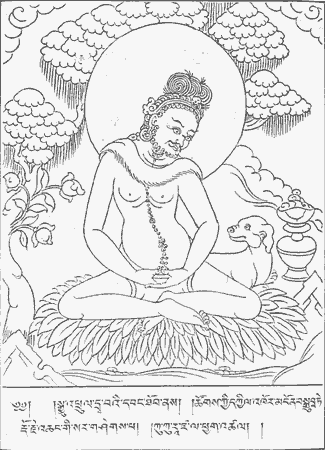 Tibetans used dogs like the Lhasa Apso as holy temple guards or good luck charms for monasteries. The Dalai Lama and the Panchen Lama often kept dogs as pets and sent dogs as gifts to other kings. Two great sages in Tibetan and Mongolian Buddhism were intimately associated with dogs -- Kukkuripa and Kukuraja.
Dogs in 'Ur of the Chaldees'
Bau was originally one of the three main deities of the Sumerian pantheon. She is portrayed as a dog-headed goddess of healing and life. Dogs are her sacred animals with dog and puppy burials found at her temples.
The belief that a dog's licking of wounds aided healing seems connected with Bau's position of goddess of physicians.
With the rise of the goddess Inanna in Sumerian religion, Bau and her various manifestations began to be assimilated by Inanna. The latter goddess had seven hunting dogs. Her husband Dumuzi is also said to have black royal dogs in the story of Inanna's descent into the underworld.
In the Old Testament, the priests of Inanna (Asherah) and Dumuzi (Tammuz) are known as kelabim "dogs."
Every year the Sumerian king took on the role of Dumuzi in a ritual marriage to Inanna for the good of the kingdom. Sumerologist Samuel Noah Kramer has suggested that the Lukur priestess played the role of Inanna in this ritual.
The Lukur maidens are the seven daughters of dog-headed Bau: Zazaru, Nipae, Urnuntaea, Hegirnuna, Heshaga, Zargu and Zurgu who served in Bau's temple. When Inanna absorbed Bau, the Lukur priestess became her devotee.
Sumerian royal inscriptions use the compound ur-sag "hero, warrior" which means literally "top dog."
In the latter religion of Babylon and Assyria, the god Bel-Merodach, king of all heavenly gods, had four dogs named Ukkumu (Seizer), Akkulu (Eater), Ikšsuda (Grasper), and Iltebu (Holder).
Europa
Leto, the mother of Apollo and Artemis, took the form of a wolf or was said to be escorted from the Hyperboreans by wolves. Artemis was known as the "Wolf Goddess" and had a wolf on her shield. Both she and her Roman counterpart Diana were accompanied by a pack of hunting dogs.
Temples to Lycian Apollo or "Wolf-like Apollo" were common in ancient Greece. Apollo was known as Lykegenes "of she-wolf descent" in reference to his mother Leto. The wolf was Apollo's sacred animal.
Even Zeus had wolf connections among the Arcadians. Zeus Lykaios or "Wolf Zeus" was the patron deity of Arcadia. There was a story that a man turned into a wolf at each yearly sacrifice to Zeus Lykaios.
The death goddess Hecate was closely linked with dogs and sometimes portrayed as dog-headed. Her special pet was Cerebos, the three-headed guard dog of the entrance to Hades. The connection of dogs to death, the underworld and resurrection may be linked to their burying and retrieving of bones and also to the practice of "dog burial" -- the devouring of corpses by dogs.

Rome was built by Romulus and Remus, both suckled by a she-wolf according to tradition. Romulus went on to become Rome's first king. Wolves were apparently sacred to the Etruscans, who formed part of the heritage of Romulus and Remus, and they made many statues of wolves.
The she-wolf of the Capitol was the emblem of Rome.
The Norse supreme deity Woden (Odin) chose two wolves, Freki and Geri, as his companions. His own death by the great apocalyptic wolf Fenrir was considered a fitting warrior's death for the god.
The underworld known as Hel to the Norse was guarded by a pack of dogs and wolves headed by the massive dog Garm.
The Celts had special relationships with dogs. The great Celtic hero Cuchulainn, whose name means the "Hound of Culann" was closely linked with dogs. He was forbidden from eating dog flesh, a common Celtic practice, but breaks this taboo leading to his death.
Unclean, but...
The brahmins of India classified the dog as unclean but this is a rather late addition to Indian culture. By no means, however, can one consider that the dog was widely deplored.
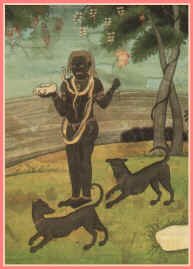 In fact, in various parts of India especially in eastern states like Orissa, the supreme godhead is represented by Bhairava, a form of Shiva, who either takes on the form of a dog or more commonly has dog companions or vehicles (vahanas). A less common manifestation of Shiva in other parts of India known as Khandoba also had the same attributes. These deities appear in Nepalese Buddhism as Yamantaka, a wrathful god who conquers the forces of death.
Interestingly in the Vedic literature, generally considered the oldest in India, many deities have dog companions. Indra, the quintessential Vedic god has as his companion and messenger the faithful bitch Sarama. She gives birth to two sons, the Sarameyas, who in turn become the companions and messengers of Yama, the lord of death.
There are also indications that Varuna, a water god who originally held a high place in the Vedic pantheon, had a pet dog. And the four great Vedic books, the Rgveda, Samaveda, Yajurveda and Atharvaveda are likened to four dogs who follow the deities Visnu, Sri and Dattatreya.
One of the most memorable dog stories from Indian literature involves the heroic Pandava brothers of the Mahabharata. When King Dharmaraja, his brothers and all their families set off on their final journey up the Himalayas, each one fell until only Dharmaraja and his companion dog were left.
As they neared the top of the mountain, they were greeted by the god Indra in his chariot. The god lauded Dharmaraja and said that he had earned a place in heaven. He bidded that the king board the chariot and has he did Dharmaraja beckoned for his canine friend. However, Indra protested saying that dogs were not allowed in his heaven.
Upon hearing this Dharmaraja said that he could not abandon such a faithful companion who depended on him. He declared he would rather stay on earth than abandon his dog. Finally Indra relented and both were taken to heaven. Upon arriving the dog transformed into the god Dharma, the lord of the correct way of living.
Among the Muslims, the dog was also generally considered unclean. However, one great exception to this rule was the Saluki breed which was proclaimed in the Koran no less as the "gift of Allah." The saluki was also known by such names as al-Hor "the Noble One," and al-Baraha "the Blessed One." The Arab literature states that the Saluki originated in the city of Saluk in Yemen. A gift of a saluki was considered a great prize.
The ancient Israelites were another people among whom the dog was considered unclean. One of the lowest slurs was to call a person a dog or a "dead dog" or "dog's head." We find the same thing in many Muslim cultures. It is thought that the Hebrews disdain for the dog may have been a reaction to dog worship among the Egyptians and Canaanites. In Ashkelon, an ancient Canaanite city, a huge dog cemetery has been excavated dating to Persian times.
The wolf though does figure prominently in the Old Testament. In Jacob's blessing to Benjamin, the tribe of the latter is likened to a wolf that devours the prey in the morning and divides the spoil at night. Some believe this may be an allusion to Saul, the first king of Israel. If so, might there a connection here to Wepwawet, the royal wolf of Egypt? Others think that this refers to the Temple that was built on Benjamin's territory and swallowed up the offerings of the people at the altar.
In latter Jewish literature, the Talmud has a warning against raising dogs in Israel comparing it to rearing swine. The medieval scholar Rashi, though, says unclean meat is always thrown to the dogs in gratitude for their silence during the Exodus from Egypt. It is also thought that the Hebrew word for dog "kalev" can mean "close to the heart" referring to the dog as a faithful companion.
There is even a thought that the phrase "dead dog" used by the Hebrew prophets was not so disparaging towards dogs after all. Dogs like prophets warn of impending misfortune, so one would pay more attention to the adjective "dead" rather than the noun "dog" in this phrase.
The rabbis did have some good things to say about our canine friend as found in this dog story:
"The Jerusalem Talmud [Schochet writes] cites as one of Rabbi Meir's fables the story of a dog who observed a serpent poisoning the curdled milk of its master. The dog barked frantically, but to no avail, as its master failed to heed its warnings and set out to partake of the milk. The desperate dog hastened to consume the food itself, thereby dying an agonizing death while saving the lives of its master and his fellow shepherds. The grateful shepherds buried the faithful dog with funerary honors and erected a monument to its memory."
Dogs and royalty
Pliny stated that among the Ethiopians there were people who kept a dog as king. They made judgements based upon interpretations of the disposition and actions of the dog king.
In China and Tibet especially, dogs appear from very early times as royal animals. From at the least the Han Dynasty, dogs had royal status. The Emperor Ling Ti (156-189) bestowed royal titles to the palace dogs as imperial guards and viceroys. This was the beginning of a tradition in which the emperor appeared with dogs forming part of the royal guard.
In fact, in the oldest known royal tomb -- that of Shang ruler Fu Hao (1250 BCE) in Anyang -- we find a pit containing the remains of six dogs under the royal corpse. Centuries later at the tomb of Marquis Yi (about 430 BCE) in present-day Hubei Province we find the coffin and remains of a dog in the tomb's eastern chamber.
The imperial family sometimes established laws against harming dogs and even took to the art of dog breeding themselves. One of the most prized gifts one could receive from the emperor was one or more of the royal dog breeds represented today probably by the Pekinese, Pug, Chow Chow and Shih Tzu.
The most well-known royal dog lover in China must be the Dowager Empress Tzu Hsi who came to power in 1861. She payed strict attention in guiding the imperial eunuchs who bred the royal dogs. Upon her death, she left a loving poem about the butterfly lion dogs she had bred, which ends with the lines:
And so (the butterfly dog) remains, but if it dies, remember that you too are mortal.
Among the priest-kings of Tibet, the Dalai Lama and Panchen Lama, and also among other grand lamas, there existed "holy dogs" as "badges" of the holy office.

The Panchen Lama was said to have two such dogs that accompanied him everywhere and were attended to by the Lo, the religious prime minister and high priest. Each dog also had its own retinue of servants.
In both Tibet and China, lion dogs, or statues of these dogs, also served as sacred guardians of temples.
The love for toy dogs was found among the royal families of Europe by at least the 15th century. The Papillion is shown in paintings of the French royal court at this time.
In the day of Francis I of France (1515-1547) the Bichon Frise dog became established in the royal court. Henry III was said to be so enamored with these dogs that he fashioned a basket to be placed around his neck to carry his pets.
The King Charles Spaniel is so named as it was the favorite of Charles II of England. Queen Elizabeth of present times has a fancy for Welsh Corgis that often appear with her in public.
In more ancient times, European kings often kept large coursing hounds. Even the legendary King Arthur was said to have a hunting dog named Caval, which means "horse." However, these large breeds did not fit well into the aristocratic courts of Renaissance Europe.
Companion of the Gods
In addition to canine or part-canine gods, dogs are also found profusely as companions of the gods. In this sense they are usually divine and immortal and in a sense gods themselves.
As noted already, Inanna, Bel Merodach, Bhairava, Khandoba, Dattatreya, Yama, Indra, Artemis, Hecate, Diana and Woden are among those who have dog or wolf companions.
In Africa, Nyambe, the Louyi creator god has a beloved dog. Nyamurairi, the supreme god of the Nyanga people of the Congo had a dog named Rukuba, who gave the gift of fire. The Yorubas have the dog-headed Aroui who also happens to have a pet dog. They also worshipped Odudua, the mother goddess whose is usually depicted with a dog, the animal sacred to her son, the war god Ogun.
The deities Legba of the Dahomey and Nzassi of the Fjort also have companion dogs.
In the ancient Samoan religion, the dog was sacred to and the companion of many of the highest gods. The pan-Polynesian goddess Hina usually is said to have one or two pet dogs. In the Philippines, Kimat is the dog of the supreme god Kadlakan and also is the personification of lightning. Among the Ifugao of the Philippines, the deities Wigan, Kabigat and Balitok all have dogs. The Apayaos of Luzon have a malevolent god Anguan who hunts people with his dogs.
Mithras, the Persian savior god, also had hunting dogs that helped him in the slaying of the bull. The dog was considered sacred to Mithras followers in ancient Europe.
The dog as ancestor and totem
Dog ancestry and totemic worship is rather widespread but particularly common in eastern Asia and North America.
The Aleuts and a number of Inuit peoples have such beliefs. So do the Athabascan Dogrib Indians and the Ojibwas (Chippewa). Around the Pacific Rim, the beliefs are found spread through Siberia, in southern China, Indochina, Java, the Philippines and New Zealand. They extend westward into Madagascar.
Studying the beliefs in South China, researcher Chungshee Hsien Liu came to the conclusion that these beliefs were of "proto-Malay" origin. Some Russian researchers such as S.I. Rudenko also thought that this concept may have originated in insular Southeast Asia possibly among the Austronesian or Proto-Austronesian peoples.
The theory is interesting in light of recent research by Peter Savolainen and others suggesting that all domestic dogs originated from a few maternal lineages somewhere in eastern Asia. Savolaninen also theorizes that the ancestor of the dingo of Southeast Asia and Australia was spread with the migrations of Austronesian speakers around 6,000 years ago.
Jonica Newby, author of Animal Attraction a history of animal domestication, thinks this points to the dingo as the earliest domestic dog and possibly the closest representative of the ancestor of all dogs. In such a case, the dingo would likely have descended from Canis lupus chanco a sub-species of the Grey Wolf in East Asia rather than Canis lupus pallipes of India, as previously thought.
The regional cult of a dog ancestor usually takes the form of a totemic dog ancestor who marries a goddess or, as in the case of South China, of a dog ancestor who marries a daughter of the Chinese emperor. The latter origin stories are widespread among the Hmong, Mien, Li, Shan, Shaka and other peoples in South China and northern Indochina.
In the Mien version of this story, the Chinese emperor Pien Hung is faced with defeat from emperor Kao Wang and offers his daughter to anyone who can defeat the invader. The three-colored dog, Phan Hu, hearing of this pentrates enemy lines, kills Kao Wang and brings back his head to Pien Hung. Taking the emperor's daughter as his wife, they produce 12 children from which spring the twelve clans of the Mien. The children disdained life in urban China and instead sought refuge in the lush mountain regions of South China.
Many Pacific coast Amerindian peoples have the wolf on their totem poles. In such cases, it usually becomes taboo to kill a wolf or consume its flesh. However, in some cases, a totem is actually sacrificed and its flesh eaten in religious ritual.
A number of peoples in West and South Africa claim a dog as ancestor including one of the more prominent Bantu groups in southern Africa. Other peoples who held such beliefs include the Kyrgyz, the Nicobarese, the Pomotu islanders, and groups in Myanmar, Papua New Guinea and formerly in Finland.
An ancient and grand legacy
As the most widespread and probably the oldest domesticated animal, the relationship between dog and humans has always had aura of mystery. Newby believes that the domestication of the dog led directly to the domestication of other animals and thus was a major turning point in the history of humans.
Scientists now wonder whether it was humans that domesticated the dog or the dog that domesticated itself. Whatever the case, the dog has learned to adapt to living with humans to a degree finer than any other animal. That the character of the dog has impressed us is without doubt as evidenced by the numerous stories and legends that have been preserved. Even those who felt the dog was beyond the pale were usually forced at some point to concede its nobler qualities.
That the dog should have been elevated to high status by some many peoples and so frequently throughout history should come as no surprise. The relationship between dogs and humans may go back 100,000 years according to some of the most recent research. That means that for some 90,000 years humans depended greatly on the dog as a helper and companion during the hunter-gatherer phase. The name of the Egyptian god Wepwawet means "opener of the way" and indeed the dog has opened the way for humankind throughout history.
Share article: Tweet
Related links
Interpretations of the Dog Husband Theme
Dog reverence in Southeast Asia and Pacific
Deluge, Gourd, Dog Husband
Single origin for domesticated dog in Southeast Asia and South China
Update: Read new research on dog origins in Southeast Asia:
Phylogenetic Distinctiveness of Middle Eastern and Southeast Asian Village Dog Y Chromosomes Illuminates Dog Origins
 If you have Google or Yahoo! toolbars, drag this link into your bookmarks toolbar to bookmark this page.
Add to reddit Add to Digg Add to Del.icio.us
Press Ctrl + D to add to your browser bookmarks.
Flagship Merchant Services listed below are not associated with credit card processing fees
Link to this page by copying and pasting the code below into the source code of your website or blog: